











Key Takeaways
- Federal law (the FOPA “safe passage” rule, 18 U.S.C. § 926A) lets an eligible traveler transport a firearm if it is unloaded, kept out of reach of the passenger compartment, and, in trunkless vehicles, in a locked container.
- A locked glove box or center console does not count as a “locked container” under federal law or under strict states like California, New York, and New Jersey, so a standalone locked steel container is what the law actually calls for.
- Whether you can keep a loaded gun in your car depends entirely on the state: it is generally allowed for eligible adults in permitless-carry states like Texas, Florida, and Arizona, but not in strict states.
- Rules change at every state line, so a driver crossing several states must confirm the law is met in every state on the route, not just the origin and destination.
- A growing number of states, including California and Colorado (whose law took effect January 1, 2025), require a firearm left in an unattended vehicle to be stored in a locked, hard-sided container out of plain view.
Understanding firearm transport laws in a vehicle is harder than it should be, because there is no single national rulebook. A driver crossing state lines faces a patchwork: what is legal at home can be a serious criminal charge two states over. Federal law sets a floor, and each state layers its own rules on top.
This article provides general educational information only and does not constitute legal advice. Firearm laws vary significantly by state, county, and municipality, and they change frequently. Verify the current laws of every state on your route with a licensed attorney or official state resources before traveling with a firearm. Tuffy Security Products is not a law firm and cannot provide legal advice. With that said, here is how the pieces fit together, whether you carry for personal protection, for sport and recreation, or as a professional such as an officer moving a duty weapon between vehicles.
Federal Firearm Transport Laws for Vehicles: FOPA and 18 U.S.C. § 926A
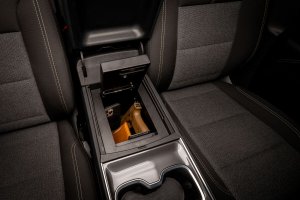
Yes, there is a federal law. The Firearm Owners Protection Act “safe passage” provision (18 U.S.C. § 926A) lets any person not otherwise prohibited transport a firearm for a lawful purpose between two places where they may legally possess it, if the firearm is unloaded and neither it nor the ammunition is readily accessible from the passenger compartment. In a vehicle without a separate trunk, both must be in a locked container that is not the glove compartment or console.
All four conditions must be met at once. The statutory text is published by the U.S. Government Publishing Office, and the ATF’s implementing regulation reproduces the same language at 27 CFR 478.38. One useful detail: federal law does not require the ammunition to be in a separate container from the firearm, only that neither be accessible.
What “Locked Container” Means
A “locked container” is a fully enclosed, separately locked case, not a compartment built into the dashboard. Under 18 U.S.C. § 926A, a trunkless vehicle must use “a locked container other than the glove compartment or console.” California takes the same approach, defining a locked container as a secure, fully enclosed case locked by a padlock, key lock, or combination lock, and expressly excluding the utility and glove compartments.
This is the most misunderstood point in vehicle transport. A lock on your factory console does not make it a compliant locked container under the § 926A text or under California’s definition published by the California Attorney General and summarized by Giffords Law Center (Cal. Penal Code § 16850). To comply, you need a standalone, fully enclosed, locked steel container.
Loaded vs. Unloaded, and Where the Ammunition Goes

For interstate transport under federal law, the firearm must be unloaded and, together with the ammunition, out of reach of the passenger compartment. Federal law does not require the ammunition to sit in a separate container from the gun. Some states are stricter: New Jersey requires ammunition to be transported separately and locked in the trunk, beyond the federal baseline.
As LegalClarity explains, federal law only requires that neither the firearm nor the ammunition be readily accessible, so you can lawfully store ammunition in the same locked case as the unloaded firearm and still comply. New Jersey goes further: New Jersey State Police guidance directs that ammunition be transported in a separate container and locked in the trunk, so gun storage in car laws on this point are set by the strictest state on your route.
Handguns vs. Rifles and Shotguns

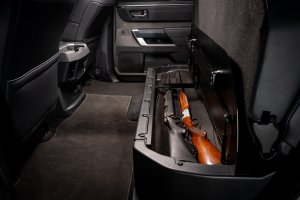
In many strict states, rifles and shotguns face fewer transport restrictions than handguns, but the “unloaded” rule still applies to everything. This is a general pattern, not a universal rule, so verify it state by state.
The California Attorney General notes that rifles and shotguns are generally not required to be in a locked container, though like any firearm they must be unloaded in transport. The Texas State Law Library found no Texas law restricting transport of a long gun in a vehicle, and the 2025 Florida Statutes (§ 790.25(4)) permit carrying a legal long gun anywhere in a private conveyance for a lawful use. Federal FOPA, however, applies to all firearms, long guns included.
State-by-State Firearm Transport Laws for Your Vehicle
State rules range from strict (a locked container is mandatory) to permissive (an eligible adult may carry a loaded handgun). The table below summarizes the in-vehicle rule for six representative states as a research starting point, not a substitute for reading each state’s current law.
|
State |
In-Vehicle Rule (Summary) |
Source
|
|---|---|---|
|
California |
Without a CCW, a handgun must be unloaded and locked in the trunk or a locked container (not the glove box or utility compartment). |
|
|
New York |
A state handgun license is required (no reciprocity); the handgun must be unloaded and secured in a locked container, with continuous, uninterrupted travel through New York City. |
|
|
New Jersey |
Firearms must be unloaded and in a closed, fastened case, gun box, or locked trunk; transport only for specific lawful purposes (home, range, repair shop). NJSP guidance also directs ammunition be in a separate container locked in the trunk. |
|
|
Texas |
An eligible adult may carry a loaded, concealed handgun in a vehicle without a License to Carry; plain view requires being 21+ and in a holster. No state restriction on long guns. |
|
|
Florida |
A person 18+ may keep a concealed firearm in a private vehicle if securely encased or not readily accessible; since July 1, 2023, eligible 21+ carriers may carry on their person. |
|
|
Arizona |
Adults 21+ may carry a loaded, concealed handgun in a vehicle without a permit; adults 18 to 20 may carry openly or store it in a case, holster, or compartment. |
Strict States: California, New York, and New Jersey
In California, an adult without a CCW may transport a handgun only if it is unloaded and locked in the trunk or a locked container, per the California Attorney General and Giffords Law Center (Cal. Penal Code § 25610). New York requires a state handgun license and does not honor out-of-state permits; the official New York State guidance notes New York City requires all guns to be unloaded, in a case, and out of sight even while you are with the vehicle. A license holder passing through the city is protected only if the trip is continuous and uninterrupted, as Giffords explains (N.Y. Penal Law § 400.00(6)).
New Jersey is among the strictest. As summarized by Giffords Law Center (N.J.S.A. 2C:39-6(g)), New Jersey requires firearms to be unloaded and in a closed, fastened case, gun box, securely tied package, or locked trunk, and transport is lawful only between specific destinations such as home, a range, or a repair shop. New Jersey State Police guidance further directs that ammunition be carried in a separate container locked in the trunk. Unlawful handgun possession there can carry mandatory-minimum penalties, so the stakes are high.
Permissive States: Texas, Florida, and Arizona
Texas allows a qualified adult to carry a loaded, concealed handgun in a vehicle they own or control without a License to Carry; the Texas State Law Library notes a handgun may be in plain view only if the person is 21 or older or holds an LTC and keeps it holstered. In Florida, the 2025 Florida Statutes (§ 790.25(4)) let a person 18 or older keep a concealed firearm in a private conveyance if it is securely encased or not readily accessible, and since July 1, 2023, eligible permitless carriers who are 21+ may carry on their person.
Arizona is a constitutional-carry state. Giffords and the Phoenix Police Department confirm that adults 21 and older may carry a loaded, concealed handgun in a vehicle without a permit (A.R.S. § 13-3102), while those 18 to 20 must carry it openly or keep it in a case, holster, or compartment. Remember: these permissive rules apply only inside the state, and they do not follow you across a stricter state’s line.
Crossing State Lines and the Limits of FOPA
FOPA’s safe-passage rule can protect an interstate traveler, but it is a limited protection, not a shield against arrest. In New York and New Jersey, courts treat § 926A as an affirmative defense, meaning you can still be arrested, your firearms can be seized, and you must raise and prove the defense in court. FOPA also requires that possession be legal at both the origin and the destination, with strict compliance the entire way.
As NY Gun Laws and New Jersey defense counsel at Lustberg Law both explain, FOPA does not prevent officers from filing charges at the roadside; the defense must be argued before a judge. To reduce risk, keep the firearm unloaded and inaccessible for the entire trip and minimize stops. The ATF has published a proposed rule that would treat reasonably necessary stops (fuel, food, overnight lodging) as protected transport, but as of this writing that is a proposed rule only, not final law, so do not rely on it. For more, see our overview of handgun storage laws.
Leaving a Firearm in an Unattended Vehicle
A growing number of states regulate how a firearm must be stored in an unattended vehicle, separate from the in-transit rules. California and Colorado are two confirmed examples: both require a firearm left in an unattended vehicle to be secured in a locked container out of plain view, and a glove box or center console does not satisfy either law. Other states have adopted similar requirements, so verify your own state’s rule.
California’s Penal Code § 25140 requires a person leaving a handgun in an unattended vehicle to lock it in the trunk, in a locked container out of plain view, in a locked container permanently affixed to the interior, or in a locked toolbox, per California’s Penal Code § 25140. Colorado’s HB 24-1348, effective January 1, 2025, requires a handgun in an unattended vehicle to be stored in a locked, hard-sided container out of plain view, according to the Colorado General Assembly bill text (C.R.S. § 18-12-114.5); a violation is a civil infraction with a maximum $500 fine. We break down that law in detail on our page about Colorado’s new vehicle storage law. In practice, a locked, hard-sided steel container mounted out of sight is exactly what these laws describe.
Firearms in School Zones
The federal Gun-Free School Zones Act (18 U.S.C. § 922(q)) restricts firearms within 1,000 feet of a K-12 school nationwide, but it includes a vehicle exception. To qualify, the firearm must be both unloaded and locked in a container, or locked in a firearms rack, on the motor vehicle. An out-of-state carry permit does not satisfy the exception unless it was issued by the state where the school zone is located.
According to LegalClarity, citing the statutory text of § 922(q), you are exempt only if the firearm is unloaded and locked in a container or firearms rack on the vehicle. Because school zones cover a wide radius in populated areas, a driver can pass through one unknowingly, so a firearm that already meets FOPA’s unloaded-and-locked storage generally satisfies the vehicle exception too.
How to Legally Transport a Firearm in Your Vehicle
The safest approach follows the strictest rule you might encounter: unload the firearm, place it in a locked, hard-sided container out of reach, keep it out of plain view, and confirm your possession is legal at both ends of the trip. Use the checklist below as a starting point, then verify the specifics for your route.
- Confirm you are legally allowed to possess the firearm and are not a prohibited person.
- Unload the firearm before it goes in the vehicle.
- Place it in a locked, hard-sided container, kept out of reach of the passenger compartment or in the trunk.
- Keep the firearm out of plain view from outside the vehicle.
- Store ammunition according to the rules of the strictest state on your route (some states, such as New Jersey, require it separate and locked).
- Confirm your possession is legal at both the origin and the destination.
- Check the law of every state you will drive through, not just where you start and stop.
- Keep the firearm secured in a locked container whenever you leave the vehicle unattended.
Choosing Secure, Compliant Storage for Your Vehicle
Across federal law and the strict states, the recurring requirement is the same: a fully enclosed, locked, hard-sided container that is not the glove box or console. That is exactly what Tuffy has engineered since 1989 as the original maker of vehicle-specific security: a locked steel container, out of plain view, built from heavy-duty cold-rolled welded steel and secured by the patented Pry-Guard system.
For everyday drivers, a console safe (which secures a handgun) drops into the existing OEM factory center console rather than replacing it, so it looks completely stock and stays reachable from the driver’s seat. It installs in about 30 minutes with basic hand tools, with no drilling on most applications, and offers keyed locks (the exclusive 10-tumbler double-bitted key) or a mechanical push-button combination (3-digit or 4-digit). All of Tuffy’s console locks are mechanical and battery-free, so there is nothing to lose power or fail in extreme heat or cold. Security here comes from concealment and delay, not from any claim of being theft-proof.
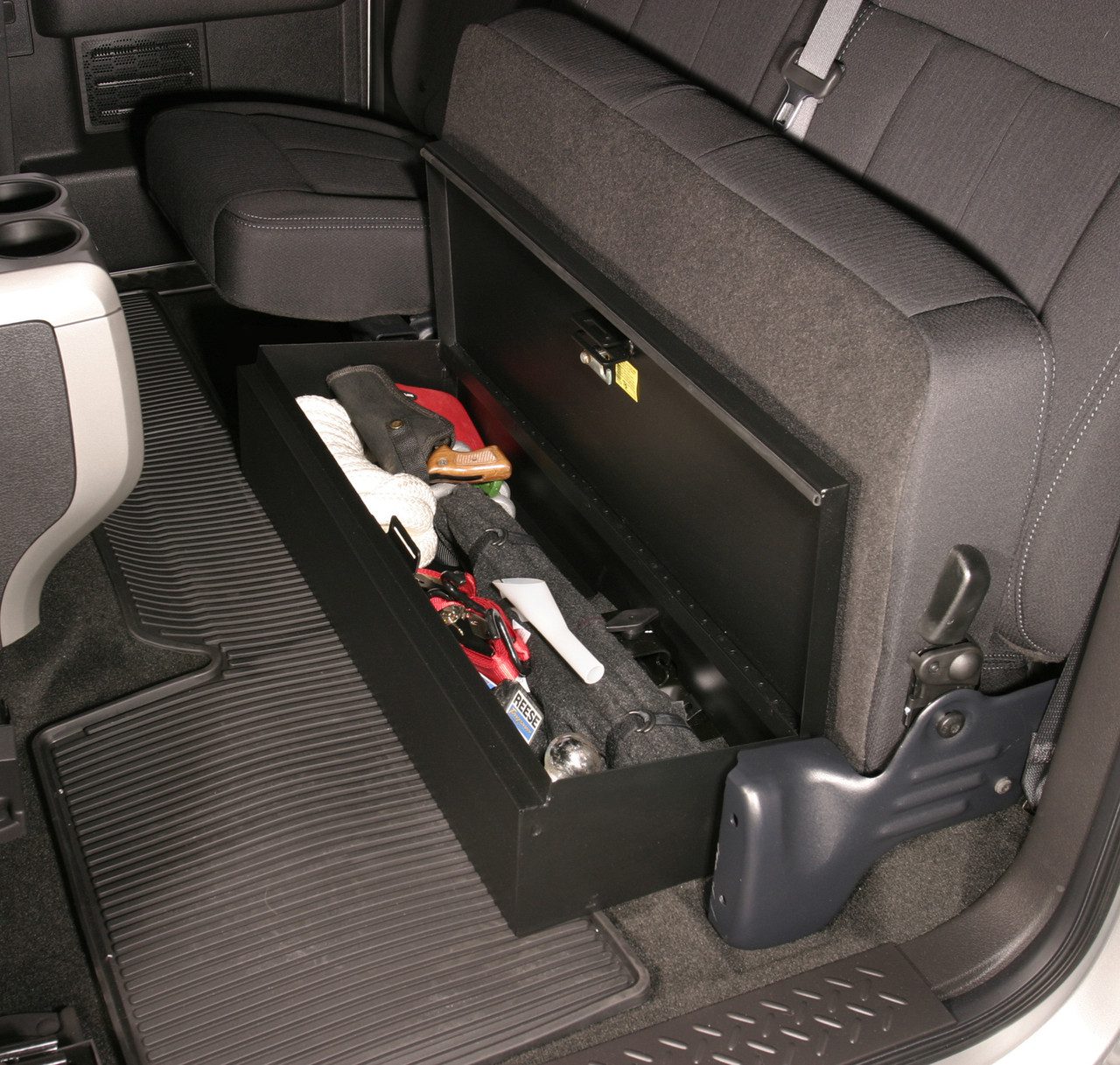
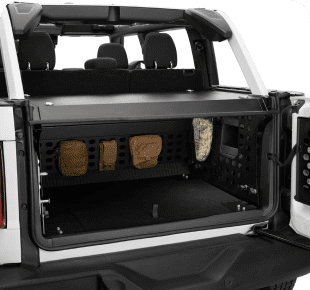
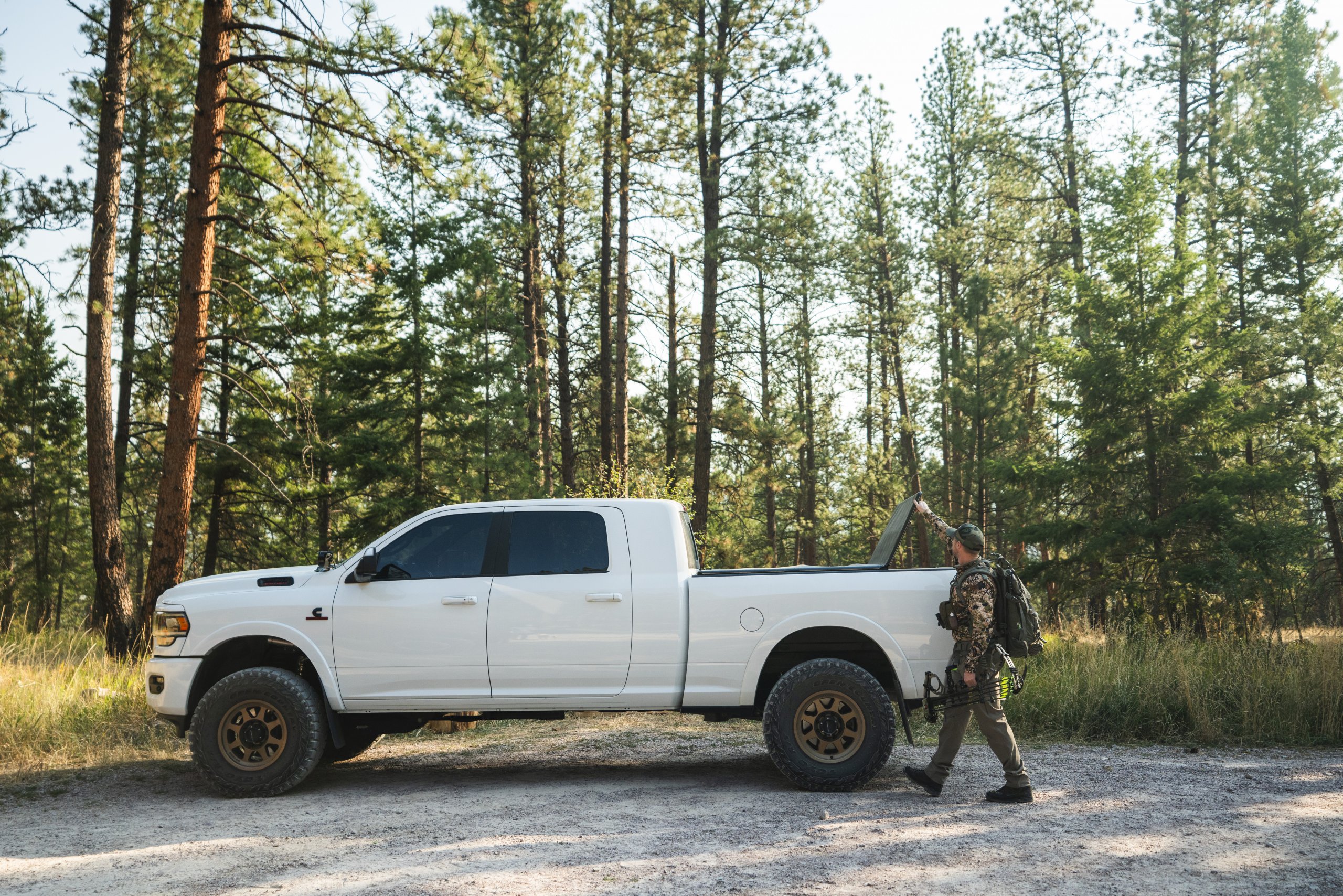
To secure a long gun or larger gear, a full-width under-seat lockbox in a crew-cab truck offers the width to stow firearms or other long items, and truck bed security handles the largest loads. These mount out of sight but are not reachable from a seat, which suits secured storage rather than quick access. If you move a firearm between vehicles or travel often, a portable safe tethers with a steel security cable and travels with you, a legitimate welded-steel solution for multi-vehicle use, not a compromise. Tuffy covers trucks, SUVs, Jeeps, and (through universal options) cars, CUVs, and UTVs across many model years; use the vehicle selector to confirm your fit and explore the full range of Tuffy security safes.
The Bottom Line
Firearm transport laws in a vehicle come down to a few durable principles: keep the firearm unloaded, keep it and the ammunition out of reach in a locked, hard-sided container that is not the glove box or console, keep it out of plain view, and make sure possession is legal at both ends of the trip. Federal FOPA sets the baseline, but it is a limited, litigated defense in strict states, and the rules shift at every state line.
This article is general educational information, not legal advice. Firearm laws change frequently and vary by state, county, and municipality, so verify the current laws of every state on your route with a licensed attorney or official state resources before you travel.
Once you know what the law requires, the hardware is the easy part. Explore Tuffy’s vehicle-specific security options, engineered and designed in the USA and shipped from the USA, and confirm your fit by year, make, and model so your locked steel storage is ready wherever you drive.
Frequently Asked Questions About Firearm Transport Laws in a Vehicle
Quick, plain-language answers to the most common questions about transporting a firearm in your vehicle. This is general educational information, not legal advice; firearm laws change often and vary by state and locality, so verify current rules for every state on your route.
Is there a federal law for transporting a firearm in your vehicle?
Yes. The Firearm Owners Protection Act “safe passage” provision (18 U.S.C. § 926A) lets a non-prohibited person transport a firearm between two places where they may legally possess it, if the gun is unloaded and neither it nor the ammunition is accessible from the passenger compartment. Without a trunk, both must be in a locked container.
Does a locked glove box or center console count as a “locked container”?
No. Federal law under 18 U.S.C. § 926A specifically excludes the glove compartment and console for vehicles without a separate trunk, and strict states like California, New York, and New Jersey exclude them too. Use a locked, hard-sided container that is not readily accessible from the passenger seat instead.
Can you keep a loaded gun in your car?
It depends entirely on your state. In permitless “constitutional carry” states such as Texas, Florida (eligible adults 21+), and Arizona, an eligible adult may generally carry a loaded handgun in a vehicle. Many other states require the firearm to be unloaded and secured. Always confirm your state’s current rule.
How do I legally transport a firearm across state lines?
Unload the firearm, place it in a locked container out of reach (or a locked trunk), keep ammunition inaccessible, and make sure possession is legal at both your start and end points. Check the rules of every state on your route, because your home permit does not override another state’s laws.
Do I have to store ammunition separately from the firearm?
Federal law does not require ammunition to be in a separate container; it only requires that neither the firearm nor the ammunition be readily accessible from the passenger compartment. Some states go further. New Jersey, for example, directs that ammunition be carried in a separate container and locked in the trunk.
Are the rules different for rifles and shotguns versus handguns?
Often, yes. In several strict states, including California, long guns do not require a locked container but must still be unloaded during transport, while handguns must be locked in a container or trunk. Federal FOPA and the Gun-Free School Zones Act, however, apply to all firearms. Verify your state’s specifics.
What does the law say about leaving a firearm in an unattended vehicle?
A growing number of states regulate this. California (Penal Code § 25140) requires a handgun left in an unattended vehicle to be locked in the trunk or a locked container out of plain view. Colorado’s HB 24-1348, effective January 1, 2025, requires a locked, hard-sided container out of plain view.
Can I have a firearm in my car near a school?
The federal Gun-Free School Zones Act restricts firearms within 1,000 feet of a K-12 school. The vehicle exception generally requires the firearm to be both unloaded and locked in a container in or on the vehicle. A carry permit from another state may not satisfy this exception.
Does the FOPA “safe passage” rule protect me from arrest?
Not necessarily. In strict states such as New York and New Jersey, FOPA operates as an affirmative defense rather than immunity, meaning you can still be arrested and have to raise the defense in court. Strict compliance, including no unnecessary stops, is essential when traveling through restrictive states.